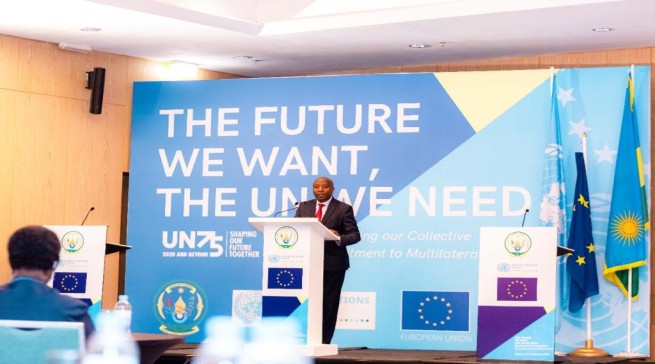
Minisitiri w'Intebe yagaragaje akamaro k'ubufatanye mu guhangana n'imbogamizi Isi uhura na zo.
The Anglo-Australian multinational company Rio Tinto â” the largest iron ore mining company in the world â” demolished two 46,000-year-old Aboriginal rock shelters in May. What is particularly disturbing about this event is that Rio Tinto was apparently acting entirely within the law, which is to say that this kind of tragic and wanton destruction will continue to happen unless stricter regulations are enacted. The sites were located on the ancestral lands of the Puutu Kunti Kurrama and Pinikura, or PKKP, people in the Pilbara region of Western Australia. Anthropological studies commissioned by Rio Tinto itself confirmed that the caves were of 'the highest archaeological significance,' containing an 'enormous museum of information about [the PKKP people's] ancestors' work and lives.'
The conflict between industry and heritage that we are witnessing today is of course not a new phenomenon. Indeed, in Australia, it has been a persistent problem since at least the early 1960s when the mining and extraction of iron ore in the Pilbara region began. But the struggle can and should be seen also within the larger context of the marginalization, subjugation, and decimation of the Aboriginal peoples that has been the story of their ongoing plight since 1788 when British settlers began colonizing the Australian mainland. Not until 1965 did most Aboriginal Australians enjoy full citizenship or voting rights; and it would take six more years before they were included on the national census. Australia's indigenous people constitute only two percent of the population and yet are 28 percent of Australia's prisoner demographic.
The unrelenting destruction of indigenous heritage sites is entirely consistent with the same ideology that has driven Australia's aggressive campaign of deforestation. Both are expressions of one and the same policy of uncompromising colonization. Over the last 200 years, Australia has lost 25 percent of its rainforest, 45 percent of open forest, and 32 percent of the woodland forest. In fact, among developed countries, Australia has one of the highest rates of deforestation, which has led to the annihilation of much of its native wildlife. Twenty percent of Australia's mammals, 7 percent of its reptiles, and 13 percent of its birds are listed as extinct, endangered, or vulnerable. According to wilderness.org.au, 1,000 plant and animal species are presently at risk of extinction.
The obliteration of the Juukan Gorge caves certainly represents a devastating loss to the PKKP â” but it is a tragic loss for the world as well. These rock shelters fostered our understanding of the human beginnings of art, religion, and culture, indeed the dawn of humanity's self-awareness â” yet, as anthropologist Marcia Langton observed, 'their significance for further understanding of deep human history is a matter that was willfully ignored by Rio Tinto.' What consequences did Rio Tinto suffer for its recklessness? Several of its executives will lose their bonuses, totaling roughly $6.7 million (USD 4.9 million) â” a mere slap on the wrist which in the absence of legislation will do nothing to protect the few similar sites that remain.
Dr. Lawrence Owens, an archaeologist and anthropologist from the University of London, told Mining Technology, 'There is no other way of putting this â” the destruction of Juukan Gorge cave was a travesty and a disgrace.' He added, 'It is difficult to fully express the magnitude of what this site was, what it meant, and how its destruction has impacted upon us all.' The caves that Rio Tinto blasted have been understandably compared to Stonehenge which is some 5,000 years old â” yet the comparison does not really do justice to what we lost, given that this site was nearly ten times older than that. Moreover, unlike Stonehenge which belongs entirely to a bygone era, these caves have been continually occupied by the same peoples, generation after generation, over these tens of thousands of years. They were a kind of 'encyclopedia of the Aboriginal people.'
One of the most precious and astounding discoveries in the cave was a 4,000-year-old length of plaited human hair, woven together from strands from the heads of several different people. This remarkable find established through DNA testing a direct link to the Puutu Kunti Kurrama and Pinikura traditional owners living today.
Rio Tinto received permission to conduct the blasts in 2013 under Section 18 of the WA Aboriginal Heritage Act. It is an offense under Section 17 of the Aboriginal Heritage Act (AHA) of 1972 to excavate, destroy, damage, conceal or in any way alter an Aboriginal site. However, under Section 18 landowners may apply for consent to breach the restrictions established under Section 17. Accordingly, Rio Tinto was not operating illegally or flouting the law.
David Ritter, former principal legal officer for the Yamatji Land and Sea Council, observed that 'It is a myth, expressed by the objects of the Aboriginal Heritage Act that the main purpose of the legislation is to protect Aboriginal heritage. It may be more accurate to describe the AHA as an act to regularize the obliteration of Aboriginal heritage⦠It is legislation by the non-Indigenous community for the non-Indigenous community that creates a superficial veneer of protection for Indigenous interests. The result is that the colonizing power can continue to do with Aboriginal places and materials exactly as it wants.'
We know that this desecration could have been avoided altogether because during a federal parliamentary inquiry, Rio Tinto's CEO, Jean-Sebastien Jacques stated that there were four options to expand the iron ore mine in the area. Three of the options would have avoided the rock shelters, but the mining company chose the more destructive alternative as it allowed them to extract $135 million (USD 97 million) worth of iron ore, a profit that exceeded the other choices. They opted for the route that allowed the company to mine '8 million tonnes of higher-grade iron ore,' according to Mr. Jacques.
It has long been recognized that Australian laws do not adequately protect Aboriginal heritage sites. The Dampier Archipelago of Western Australia is home to thousands of Aboriginal pictographs, and perhaps the oldest surviving rock art in the world. Indeed, Australia's Indigenous art represents the longest uninterrupted tradition of art in the world â” going back over 50,000 years â” with examples having been found that depict long-extinct megafauna; including the Thyalacine (Tasmanian tiger) and Fat-tailed Kangaroo. Representations of the now-extinct marsupial lion have also been found in the Kimberley region of Western Australia.
The extraordinary rock art of the Dampier Archipelago easily constitutes the largest and most diverse gallery of petroglyphs in the world. Recent archeological research confirms that the Dampier Archipelago and Burrup Peninsula (formerly known as Dampier Island) contains the largest concentration of ancient rock art in the world. However, the rock art of the Burrup Peninsula has been physically destroyed by construction and eroded by industrial emissions, continually 'under threat due to high concentrations of acidic and nitrate-rich pollution from nearby industrial complexes,' according to a 2017 report published by the Journal of Archeological Science.
What we know is that the cultural and scientific significance of the rock art is comparable to 'such world-renowned prehistoric art galleries as the caves of Lascaux in the Dordogne, and Altamira in northern Spain'. The tragedy is that we are losing the cultural riches of these regions before we have had a chance to truly understand their significance â” for, as a 2006 report prepared for the National Trust of Australia (WA) states, 'numerous petroglyphs and other archaeological features have been destroyed and a significant portion of the extraordinary heritage of the Dampier Archipelago has been irretrievably compromised without any clear understanding of what has been lost.'
Aboriginal people represent the oldest continuous culture in the world ┠adequate protection of that culture will be encouraged when we respect and appreciate the wisdom of the Aboriginal people and their genius for 'living with and fostering their environment.' We may, for example, view Aboriginal rock art as disrupting the dualistic, Cartesian view of the landscape, offering instead an embodied approach which recognizes that we 'do not live in an environment. Such a position immediately posits our separation. Rather we have an environment and we are part of it and it is part of us⦠We are⦠immersed.' In Animism: Respecting the Living World (2005), Graham Harvey observes that '[W]e have far too many experiences of the aliveness of the world and the importance of a diversity of life to fall in step completely with Cartesian modernity.' We need to broaden the interpretative lens with which we view Aboriginal rock art and see that in fact, it represents an important challenge, and possibly a corrective to an overly dualistic ontology, which pits nature versus culture, mind versus body, and human versus non-human.
Source : https://taarifa.rw/destruction-of-juukan-cave-a-loss-to-humanity/

Source : https://igihe.com/imikino/football/article/armel-ghislain-muri-rayon-sports


Inama ya Komite Nyobozi ya FERWAFA yateranye ku italiki 4 Nzeri 2020 yafashe umwanzuro ku ikoreshwa ry’inkunga igenewe umupira w’abagore itangwa n’ishyirahamwe ry’umupira w’amaguru ku isi (FIFA).
Iyi nkunga yiswe FIFA WOMEN FOOTBALL GRANT igenewe amakipe yo mu kiciro cya mbere n’icya kabiri mu bagore azaba yiyandikishije gukina amarushanwa y’umwaka wa 2021 n’ayo mu mwaka wa 2022 agatangwa mbere y’uko imikino itangira.
Iyi nkunga ikaba iteganyirijwe gusa ibikorwa by’amarushanwa bikurikira:
Iyi ngengo y’imari yose ikaba ari amafaranga y’u Rwanda 466,955,000 angana n’ibihumbi magana atanu by’amadolari ya Amerika (500,000 USD)

Niba usinzira bikugoye, kunywa amata mbere yo kuryama bizagufasha. Ni ukubera ko ibikomoka ku mata cyangwa amata ubwayo arimo tryptophan ifasha mu gusinzira. Byongeye kandi, amata arimo na hormone yitwa melatonin igenzura gusinzira no gukanguka.
Niba udashobora gusinzira bihagije nijoro cyangwa ukaba uhangayikishijwe cyane no gusinzira, ushobora gufata ikirahuri cyuzuye cy’amata kugirango bigufashe gusinzira neza.
Kunywa amata mbere yo kuryama hari abantu babigize akamenyero aho babikora kuko bizera ko amata ashobora gutuma basinzira vuba kandi neza. Abandi babikora kugira ngo bibagabanyirize agahinda kandi baruhuke na mbere yo gusinzira.
Ubushakashatsi bwinshi bumaze kwerekana ko kurya ibikomoka ku mata nk’amata na foromaje mbere yo kuryama bituma umuntu abasha gusinzira. Abahanga bavuga ko ibyo byose bituruka ku bice bimwe biboneka mu mata.
Amata arimo imisemburo ya melatonin na aside amine tryptophan, byombi bigira ingaruka nziza ku bantu, bikatworohera kwinjira mu bitotsi. Ubushakashatsi bumwe bwagaragaje kandi ko bigabanya guhangayika no kwiheba bikunze kugaragara mu gihe cyo kuryama.
Ku bitotsi byinshi, tryptophan ifasha umubiri w’umuntu kurekura imiti ya neurotransmitter serotonine igabanya amaganya kandi bigatuma umubiri wumva uruhutse. Hagati aho,melatonin ifasha kugenzura injyana ya circadian kandi igatuma ubwonko bubasha kwinjira mu bitotsi.
Abahanga bamwe ntibavuga rumwe kuri iyi ngingo bashingira ku kuba amata ashobora gutera umubyibuho ukabije bitewe n’uko arimo ibinure, proteyine, na karori usibye intungamubiri n’imyunyu ngugu kandi nanone bakavuga ko gusinzira cyane nijoro bishobora gutuma umuntu yiyongera ibiro.
Gusa Livestrong.com yatangaje ko kunywa amata mbere yo kuryama bishobora guhungabanya igogora, bikagira ingaruka kuri metabolisme, kandi bikaba byanatera kwiyongera ibiro bitifuzwa gusa ibi ntibyagatumye habaho kureka kunywa amata nijoro Ahubwo abantu bakwiye kujya banywa amata byibuze amasaha abiri mbere yo kuryama kugirango bishimire ibyiza byayo mu gihe cya nijoro.
Usibye guusinzira neza, kunywa amata ni ingenzi kuko ari umuco wo kurya neza. Kunywa amata mbere yo gusinzira bifite inyungu nyinshi kuko byongera ubudahangarwa bw’umuubiri, bityo bigatuma ubyuka umeze neza ku munsi ukurikiyeho. Kunywa amata mbere yo kuryama ni umuco mwiza dukwiye gutoza abana bacu bakawukurana bikazabagirira umumaro mu buzima bwabo bwose.
Source: www.themattresswarehouse.co.za, inyarwanda.com
Source : https://agakiza.org/Wari-uzi-ko-kunywa-amata-mbere-yo-kuryama-ari-byiza.html

Ugiye kubarura abantu barya imbuto, imboga rwatsi, banywa amazi, usanga ari bake cyane ku buryo usanga hari n’ababyirengagiza nkana. Nyamara, ubushakashatsi bugaragaza ko ari ingenzi mu buzima bwa muntu.
Mu mbuto usangamo nka avoka, umwembe n’ibindi. Avoka ni urubuto abantu badakunze kwitaho ku mafunguro yabo kandi ifitiye akamaro gakomeye umubiri wabo.
Mu kiganiro IGIHE yagiranye n’inzobere mu buvuzi Mbonezamire, Mukakayumba Anastasie, wanashinze ivuriro mbonezamirire ryitwa La Pervenche, yasobanuye ko imbuto zose zigira umumaro mu mubiri kandi buri rubuto rwose rugira umwihariko warwo ari yo mpamvu nta rubuto umuntu akwiye kurya ngo areke urundi.
Ati 'Buri wese agize amahirwe buri rubuto yagenda aruryaho cyeretse afite uburwayi bwaba bumubuza kurya urubuto runaka'.
Urugero nk’inanasi ni urubuto rwiza ruboneka mu buryo budahenze ariko hari uburwayi bw’igifu, akenshi abantu bafite ubwo burwayi ntabwo bakoresha inanasi kuko ngo ishobora no kubatera 'allergie’.
Mukakayumba ati 'Nibura abantu batabona imbuto zihagije z’amoko atandukanye, bakagombye kugira urubuto barya ku munsi'.
Abahanga mu buzima bavuga ko avoka ikungahaye kuri Potassium, Fiber na Vitamine B, C, E n’izindi vitamine nyinshi ndetse ikaba ikungahaye ku bushobozi bwo kurinda umutima kuba wafatwa n’indwara zitandukanye.
Avoka zigira uruhare mu kurinda uturemangingo dutuma uruhu rugaragara neza kandi ntirupfe gufatwa n’indwara mu buryo bworoshye.
Umwembe ni urundi rubuto rufitiye umubiri akamaro kuko ukungahaye kuri vitamine C ikenerwa mu gukora Protéines z’ingenzi ku menyo, imikaya, amagufwa, imiyoboro y’amaraso no mu gukiza ibisebe.

Umwembe unagira uruhare mu gukora indurwe y’umwijima kandi ikanafasha mu ikoreshwa ry’umunyungugu wa Fer wongera amaraso mu mubiri.
Imboga rwatsi zifite akamaro gakomeye cyane mu buzima bwa muntu. Kurya imboga bituma umubiri ubona ibyitwa 'acido-basique’ bikenerwa cyane mu maraso. Imboga cyane cyane imboga rwatsi, zifitemo ibintu byongera amaraso kandi bikayongerera n’ubwiza.
Imboga z’ubwoko bwose zikungahaye ku ntungamubiri zitandukanye, ubutare na vitamine nyinshi umubiri w’umuntu ukenera. Ikindi cyiza cy’ imboga ni uko zitigiramo ibintu bibyibushya, ku buryo uzirya kenshi nta kibazo cy’umubyibuho udasanzwe yahura na cyo.
Mu by’ukuri, imbuto n’imboga rwatsi ziba zigomba kuboneka ku mafunguro ya buri munsi kuko biri mu bifasha mu kurinda indwara ku mubiri wacu kandi nanone mu mbuto n’imboga rwatsi niho dusanga cyane vitamin A, B, C, K, imyunyungugu hamwe na potassium.
Amazi nayo agira umumaro ukomeye cyane mu buzima bw’umuntu kuko umuntu muzima agomba kuba afite amazi hagati 60% na 65% kugira ngo umubiri ukore neza.
Mu gitondo umuntu abyutse akwiriye kunywa amazi, ayo mazi afasha umubiri gusohora imyanda iherereye mu kanwa, mu muhogo, mu mara, mu mpyiko no mu ruhago, imyanda yose igasohoka mu buryo butagoranye.
Kwihagarika umaze kunywa amazi mu gitondo ni kimwe mu bintu bifasha umubiri gukora neza. Andi mazi akwiriye kunyobwa ku manywa, habura iminota 30 ngo umuntu afate ifunguro.
Aya mazi nayo yoza igifu, akaruhura umubiri wari urushye, akamara inyota, akaruhura ingingo zari zigiye kugwa agacuho.
Andi mazi anyobwa nimugoroba habura iminota 30 ngo umuntu afate ifunguro. Urugero rusange rw’amazi ku muntu ukuze wese agomba kunywa ni litiro imwe n’igice ku munsi. Igihe umuntu atayanyoye agomba kumva ko ahuye n’igihombo kuko byamuviramo no kurwara bya hato na hato.
Source:Igihe
Source : https://agakiza.org/Amwe-mu-mafunguro-abantu-batitaho-kandi-afitiye-akamaro-kanini-umubiri.html


Source : https://igihe.com/imikino/football/article/ilkay-gundogan-yanduye-coronavirus